Morrison C
Mariners' Museum, Uncurated Search Results
Type: Skipjack
Year: 1908
Builder:
Location: Thomas
These records are found in the online catalog of The Mariners’ Museum and Park in Newport News, Virginia. Uncurated search results are presented to give researchers and interested readers an idea of whether the museum’s archives contain information about this vessel and whether it may be worthwhile to visit the museum’s catalog search page for further investigation. Uncurated results may be inaccurate or incomplete.
Search mode: Exact Name. Search phrase(s): "Morrison C". Results returned: 3. Results displayed in this table: 3.
Use these buttons to send uncurated search results to your own app or text document for further research. First, check the box for any row, or click "Select All" then uncheck any rows. Then click "Show Selections". You can then copy your selections from the text box and past them into your app.
| Fetch? | Row ID | Media | Date | Vessel | Place | Related Places | Inscription/Marks | Subject | Notes | Archive Number |
|---|---|---|---|---|---|---|---|---|---|---|
| 1 | 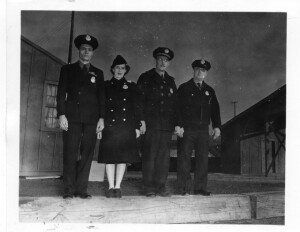 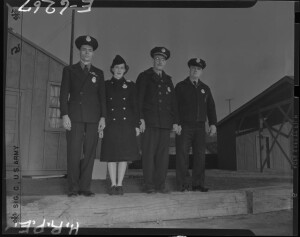 | 2/3/1944 | United States. Army. | United States–Armed Forces–Civilian employees. | E6267 - Civilian gruard[sic], left to right, W. Mathis, Mrs. F. A. Morrison, C. P. Beal, J. P. Duff. shown in back of civialin[sic] guard headquarters. 2-3-44 Official Photograph, U. S. Army Signal Corps, HRPE, Newport News, Va. | Portraits, Group. | Four civilian guards in uniform stand in a row together in front of long, low buildings. | P0003/01-#E-6267 | ||
| 2 | 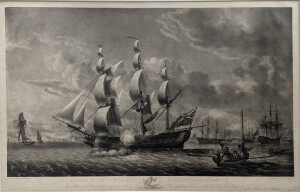 | SHORT DESCRIPTION: Aquatint drawn and aquatinted by Robert Dodd, engraved by C. Morrison, and published by Robert Pollard with the title "An Outward Bound East Indiaman Sailing from the Downs." The image shows a port broadside view of the East India Company ship Minerva firing a salute as it sails from the Downs. Numerous ships (British and Dutch) are anchored in the background at the right. Two small boats at the lower right corner, one sailing but with the sail furled and one rowing, full of rowers and passengers, including women, passengers wave at the vessels with their hats and handkerchiefs. Numerous ships are under sail in the background at the left. The white cliffs of Dover, South Foreland lighthouse and town of Dover can be seen in the background to the left of Minerva's bow. NOTES: This aquatint was evidently made from the original watercolor Robert Dodd painted in 1788. See QW72 in the Mariners' Museum collection for the original image. The original watercolor had a glass mat with the title "The Honble East India Company's ship MINERVA sailing from the Downs" but there is nothing on the original watercolor credit the vessel as the East India Company ship Minerva. VESSEL INFORMATION: VESSEL: MINERVA VESSEL: FULL-RIGGED SHIP BUILD DATE: 1786 BUILDER: PERRY BUILDER LOCATION: BLACKWALL DIMENSIONS: reported 780 to 799 tons, 143'7" length x 35'11" beam x 14'9" depth of hold FATE: Rowan Hackman in "Ships of the East India Company" states that Minerva was sent to India in 1800 and sold to local buyers. However, Lloyd's Register continued to carry Minerva until 1805. VESSEL HISTORY: Minerva was launched as an East Indiaman in 1786. She made seven voyages for the British East India Company (EIC), and one carrying rice from Bengal for the British government. EIC voyage #1 (1787–1789): Captain Robert Fairfull sailed from Portsmouth on 1 April 1787 bound for Madras and Bengal. Minerva reached Johanna on 6 July and Madras 30 July, and arrived at Diamond Harbour on 13 August. She was at Cox's Island on 15 December and Madras on 27 December. She returned to Bengal, at Ingelli on 26 January 1788. She sailed to Madras, where she arrived on 4 March, and then on to Bombay, where she arrived on 12 April. From Bombay she sailed to China, stopping first at Penang on 24 June. She arrived at Whampoa Anchorage on 1 August. Homeward bound, she crossed the Second Bar on 26 November, reached St Helena on 4 March 1789, and arrived at the Downs on 6 May. EIC voyage #2 (1790–1791): Captain Fairfull sailed from Portsmouth on 5 January 1790, bound for China. Minerva reached Madras on 2 May and Penang on 27 June. She arrived at Whampoa on 5 August. Homeward bound, she crossed the Second Bar on 14 November, reached the Cape on 9 April 1791 and St Helena on 28 April, and arrived at the Downs on 27 June. EIC voyage #3 (1793–1794): War with France had broken out shortly before Minerva was to sail on her next voyage. Captain Kennard Smith acquired a letter of marque on 7 March 1793.[4] he sailed from Portsmouth on 5 April 1793. Minerva arrived at Whampoa on 10 September. Homeward bound, she crossed the Second Bar on 18 November, reached St Helena on 11 APril 1794 and Galway on 20 July, and arrived at the Downs on 26 August. EIC voyage #4 (1795–1796): Captain Smith sailed from the Downs on 24 May 1795, bound for Madras and Bengal. Minerva reached Madras on 2 September and arrived at Diamond Harbour on 5 October. Homeward bound, she was at Cox's Island on 4 December, Madras on 6 January 1796, and the Cape on 26 April. She reached St Helena on 30 May and arrived at the Downs on 3 August. EIC voyage #5 (1797–1798): Captain Smith sailed from Portsmouth on 6 April 1797, bound for Madras and Bengal. Minerva reached Madras on 27 July and Penang on 12 October, and arrived at Diamond Harbour on 25 November. Homeward bound she was at Saugor on 28 February, Colombo on 1 April, and the Cape on 22 June. She reached St Helena on 5 August, and arrived at Long Reach on 22 October. EIC voyage #6 (1799–1800): Captain Smith sailed from Portsmouth on 24 April 1799, bound for Madras and Bengal. Minerva reached Madras on 25 August and arrived at Diamond Harbour on 15 September. Homeward bound she was at Saugor on 7 December, the Cape on 27 April 1800, and St Helena on 9 June. She arrived at the Downs on 23 September. EIC voyage #7 (1801–1802): John Atkins tendered Minerva to the EIC in December 1800 to bring rice back from Bengal for Britain. The tender was accepted and Captain George Richardson acquired a letter of marque on 16 December. Minerva was one of 28 vessels that sailed on that mission between December 1800 and February 1801. Captain Richardson sailed from Portsmouth on 12 February 1801 and arrived at Diamond Harbour on 21 June. Minerva was at Calcutta on 5 July and Fultah on 18 August. She reached St Helena on 3 January 1802, and arrived at the Downs on 22 February. On 30 March 1802 the Court of Directors of the United Company of Merchants trading with the East Indies (the EIC), announced that on 22 April they would offer for sale 37,000 bags of rice brought by Hind, Hope, Minerva, Ceres, and Bellona. | CL18853 | |||||||
| 3 | 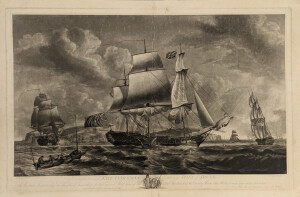 | SHORT DESCRIPTION: Black and white aquatint titled "A Homeward Bound East Indiaman, Taking a Pilot off Dover." Drawn by Robert Dodd and engraved by C. Morrison. Published by Robert Pollard in London on February 22, 1787. The image shows a starboard broadside view of an East India company ship hove-to and taking on a pilot off the coast of Dover. The image appears to show the same ship in three positions. The strait is full of vessels under sail. The port of Dover is in the background behind the stern of the center vessel. A small boat with two masts (no sails rigged) and four men is in the lower left corner. The white cliffs of Dover are in the background and Dover Castle can be seen above the foredeck of the vessel. The South Foreland Lighthouse is visible on the edge of the cliff near the bowsprit of the vessel. The ship has a figurehead of an Arab with a turban. NOTES: The Royal Museums Greenwich website believes this image illustrates the East India Company ship Dutton. The attribution was made from a watercolor drawing in their collection (PAH8436) of a similar image with the title "The Dutton Indiaman Homeward-bound taking in a Pilot off Dover." The artist is identified by RMG as "F., R.". On July 2, 2025, Christie's live auction 23860, lot 218, was a painting by Robert Dodd titled "The East Indiaman William Pitt, in three positions off Dover." The lot essay states: The William Pitt was owned by Sir Robert Preston, and her Captain was Charles Mitchell who was later knighted and in whose family the present painting descended for almost two centuries. She sailed on her first voyage from the Downs on 26 March 1786, returning in May the following year. She made six voyages in total for the British East India Company, always under the same owner and captain; during her fourth she served as an ad hoc warship in a naval campaign and saw action. She was eventually sold for breaking up in 1809. Here the William Pitt is shown in three positions off Dover. Ships bound for the Atlantic Ocean and the West and East Indies had to negotiate the busy Narrows (the Straits of Dover), winds permitting. In the left background the ship, sailing up Channel, fires a gun and hoists the Union flag at the fore topgallant masthead to request a Pilot, who is seen setting off in a lugger to the right of the William Pitt. In the centre the ship is shown in profile, hove-to (with sails backed to take the way off the ship) and hauling down the Union as the Pilot comes on board from his lugger alongside. At the right the Indiaman stands away for the Downs and the hazards of the Forelands, Goodwin Sands and the Thames Estuary. The Merseyside Maritime Museum holds a painting (or watercolor) of an image nearly identical to the aquatint. It has been attributed to Robert Dodd. It is not attributed as any particular vessel. VESSEL INFORMATION: VESSEL NAME: DUTTON VESSEL TYPE: FULL-RIGGED SHIP, EAST INDIAMAN BUILDER: JOHN BARNARD BUILDER LOCATION: BARNARD'S THAMES YARD AT DEPTFORD BUILD DATE: 1781 SHIPOWNER: HENRY RICE DIMENSIONS: reported between 761 and 780; 142'9" length x 35'2" beam x 14'9" depth of hold FATE: Dutton put into Plymouth on 25 January 1796. The next day she dragged her anchors in a heavy gale and grounded under the Citadel flagstaff at Plymouth. Edward Pellew, captain of HMS Indefatigable, swam out to the wreck with a line and, with help from Lieutenant Jeremiah Coghlan, helped rig a lifeline that saved almost all aboard. For this feat he was created a baronet on 18 March 1796. Somewhere between two and 20 men were lost. Dutton had broken her back and was a total loss. The wreck was sold for £850. VESSEL HISTORY: She made five voyages for the British East India Company. EIC voyage #1 (1782–1784): Captain James West sailed from Portsmouth on 6 February 1782, bound for Madras, Bengal, and China. Dutton reached Rio de Janeiro on 30 April, Mozambique on 8 August, Bombay on 6 September, and Madras on 19 October. She arrived at Diamond Harbour on 8 December. Sailing for China, she was at Kedgeree on 15 January 1783. She reached Malacca on 22 August and arrived at Whampoa anchorage on 25 September. Homeward bound, she crossed the Second Bar on 5 December, reached St Helena on 22 March 1784, and arrived at Long Reach on 29 May. EIC voyage #2 (1785–1786): Captain West sailed from Portsmouth on 17 April 1785, bound for Madras and Bengal. Dutton reached Johanna on 1 August, Madras on 7 September, and Cox's Island on 25 December. Homeward bound, she reached St Helena on 23 May 1786 and arrived at The Downs on 8 August. EIC voyage #3 (1788–1789): Captain James Hunt sailed from The Downs on 7 January 1788, bound for Bombay and China. Dutton reached the Cape of Good Hope on 28 March, and Bombay on 6 June. She arrived at Whampoa on 5 October. Homeward bound, she crossed the Second Bar on 3 January 1789, reached St Helena on 29 April, and arrived at Long Reach on 12 July. EIC voyage #4 (1791–1792): Captain James Hamilton sailed from The Downs on 27 March 1791, bound for Madras and Bengal. She reached Maio, Cape Verde, on 3 May and Madras on 12 August, and arrived at Diamond Harbour on 1 September. Homeward bound, she was at Saugor on 17 February 1792, reached Madras on 28 March and St Helena on 8 October, and arrived at Long Reach on 13 December. EIC voyage #4 (1794–1795): Captain Peter Sampson acquired a letter of marque on 19 November 1793. The British government held Dutton at Portsmouth, together with a number of other Indiamen in anticipation of using them as transports for an attack on Île de France (Mauritius). It gave up the plan and released the vessels in May 1794. It paid £2,687 10s for having delayed her departure by 129 days. While Dutton was at Spithead, a mutiny broke out among the crew after Sampson had sent for a boat from a nearby warship to press some unruly members of his crew. Captain Haldane of Melville Castle rowed over to Dutton. He went on board where he talked with the mutineers, arresting the ringleaders and convincing the rest to return to work. Dutton sailed from Portsmouth on 2 May 1794, bound for Madras and Bengal. She reached Madras on 11 September. She apparently did not go on to Bengal as by 7 January 1795 she was at St Helena and by 25 July at Long Reach. VESSEL INFORMATION: VESSEL NAME: WILLIAM PITT VESSEL TYPE: FULL RIGGED SHIP BUILDER: PERRY BUILDER LOCATION: BLACKWALL BUILD DATE: 1785, launched November 16, 1785. DIMENSIONS: 798 tons, 143'7-1/2" length x 35'11" beam x 14'9-1/2" depth of hold FATE: sold for breaking up 1809 VESSEL HISTORY: William Pitt made six voyages for the British East India Company. 1st EIC voyage (1786–1787): Captain Charles Mitchell sailed from the Downs on 26 March, bound for Madras and Bengal. William Pitt reached Madras on 26 July and Diamond Point on 14 August. She arrived at Cox's Island on 13 December. Homeward bound, she sailed from Cox's Island on 2 January 1787, reached St Helena on 13 March, and arrived back at the Downs on 15 May. 2nd EIC voyage (1788–1789): Captain Mitchell sailed from the Downs on 5 April 1788, bound for Madras and Bengal. William Pitt reached Madras on 13 July and Diamond Point on 23 July. Homeward bound, she sailed from Saugor on 15 November, reached St Helena on 20 January 1789, and arrived at the Downs on 23 March. 3rd EIC voyage (1790–1791): Captain Mitchell sailed from the Downs on 19 April 1790, bound for Bengal and Madras. William Pitt arrived at Diamond Harbour on 6 August. Homeward bound, she was at Saugor from 2 January 1791 to 6 February. She reached Madras on 14 February and the Cape on 11 April. She reached St Helena on 2 May and arrived back at the Downs on 30 June. 4th EIC voyage (1793–1795): Captain Mitchell acquired a letter of marque on 25 April 1793.[2] He sailed from Portsmouth on 22 May 1793, bound for Madras, Bengal, and Benkulen. William Pitt reached Madras on 18 September and Diamond Point (probably a mis-transcription for Diamond Harbour), on 2 October. She arrived at Saugor on 29 November. 5th EIC voyage (1796–179): Captain Sir Charles Mitchel sailed from Portsmouth on 12 April 1796, bound for the Cape, Madras, Bengal, and Bombay. William Pitt reached Simon's Bay on 21 July and Madras on 17 November. She arrived at Trincomalee on 19 December, and returned to Madras on 4 January 1797. She arrived at Kedgeree on 1 February. Bound to Bombay, she was at Mahé on 30 April and Calicut on 2 May. She arrived at Bombay on 26 May. Homeward bound, she sailed from Bombay on 9 August, and reached the Cape on 16 October. She was at St Helena on 3 December and arrived home on 31 January 1798. 6th EIC voyage (1799–1800): Captain Sir Charles Mitchell sailed from Portsmouth on 2 April 1799, bound for Madras and Bengal. William Pitt reached Madras on 4 August and Diamond Harbour 30 August. Homeward bound, she was at Saugor on 20 November and sailed on 11 December. She reached Madras on 20 December and Colombo on 30 December. She was at Point de Galle on 6 February 1800. She reached St Helena on 27 April and Cork on 29 June. She arrived back at the Downs on 5 July. Between 1802 and 1809 William Pitt was employed as a troopship and a West Indiaman. In 1809 she was sold for breaking up. | CL18854 |
Created 2026 by Don Barker, CBMM volunteer, for the Chesapeake Shipbuilding Project. shipbuilding@sailingworkboats.es